Saturday, 23 May 2015

Escaping to Munsyiari

Delhi is extremely hot and I am always on the lookout for an escape.  So when my colleague said that she was planning to go to Munsiyari for two weeks and was I interested, I jumped at the opportunity. The only problem was that I could spare just 5 days.  On 20th of this month, Nanku Ram, the gardener, went on his annual leave, which meant that I had to get back to Delhi by 20th to take care of the garden.  Five days is better than none was my philosophy when I accepted her offer.
The cheaper way to get to Munsiyari from Delhi is to take the train to Kathgodam.  From Kathgodam, you get jeeps going up to Munsiyari.  However, given the time constraints and the fact that train tickets were not available, we decided to drive up there.  Fortunately, my maid's husband is a good driver (that is to say my parents trust him) and he has a car. 
We left Delhi on 15th around 4.30 am and promptly got stuck in Ghaziabad/Sahibabad area. I got a nice view of the apartment complexes being built around this area. I do not know who likes to have addresses as VVIP Address Towers but yes, one of the apartment complex is named as VVIP Addresses.
Once we got onto National Highway, the ride was smooth till we hit Rampur.  From Rampur to Rudrapur, the road is horrible and filled with potholes.  From Rudrapur onwards, the roads improved and we very much enjoyed the drive.  The best thing was we could tell Rajinder, our driver, to stop because we wanted to take a picture of the view or to take a closer look at the bird.  The other important thing, from my perspective, was that Rajinder drove slowly so that I did not get nauseous.  
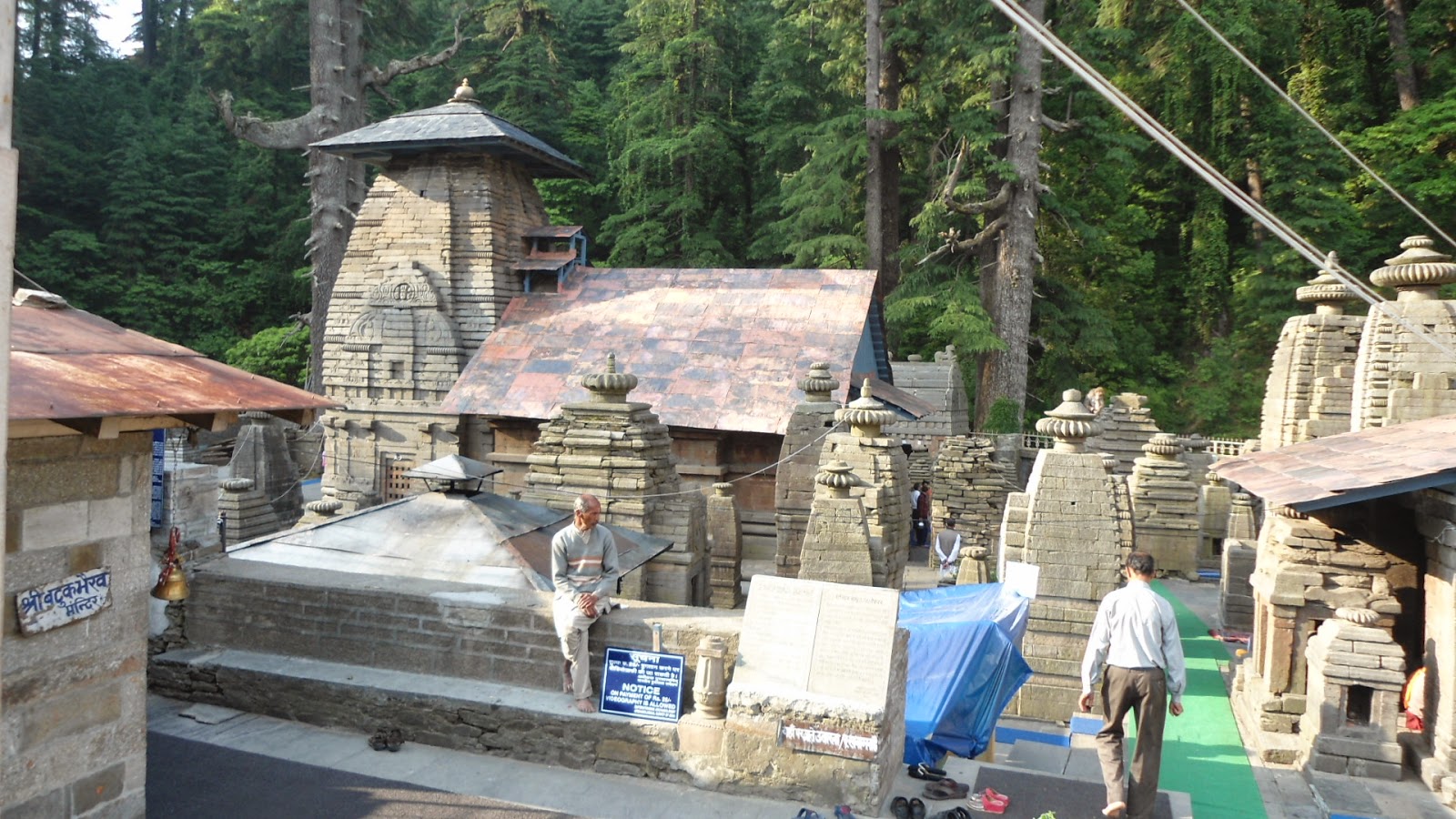
We stopped at Jageshwar at a resort that belonged to my colleague's friend who is a tour operator.  The resort, Van Serai, was awesome. The rooms were comfortable and completely insulated so that we did not feel the cold seeping through the walls as it happens in Delhi.  Next morning, we went around Jageshwar.  The place is famous for its temples which are under ASI protection though puja is performed.  The main deity is Shiva in the form of Jageshwar and Mritunjaya.  These temples are believed to have been built in 12-13th century and are grouped together in one complex.


We left Jageshwar around 8.30 am and started our journey towards Munsiyari. 


As we reached DhaulChinna we realized that we might not have enough petrol to get back.  At the next stop, Sheraghat, we enquired about petrol and were told nothing is available.  We started panicking but a helpful hitchhiker told us that we will get it at the next stop- Berinag.  We did not believe him but when we reached Berinag and saw a Maruti outlet, we knew we would get petrol.  Which we did both at Berinag and at the next stop-Thal.
The immediate worry over, we sat back to enjoy the remaining drive. Now we could see the snow-capped peaks.  We could also hear the blue whistling thrush, and see the Himalayan Bulbul along with the red-capped bulbul.

And a rainbow:

Munsiyari is at 2250 meters above the sea level and the road winds through the mountains. Truthfully, my heart hit the shoes every time we went around the bend which was every few seconds.  This is not a road to be ventured on after dusk.
From Munsiyari we could see the Panchchauli peaks beyond which is the Tibet border.  In the morning, when I woke up, I pulled aside the curtain to take a peak.  We were lucky. It was one of those perfect days, cloudless, and we drank the sight of those mountains.


At Munsiyari, we stayed with a family who does Home Stay.  The room allotted to us was comfortable and again well-insulated with all the facilities. 
The next day, 17th, a mela had been organized and we climbed up the mountain to reach the venue. The mela was fun, and who knew that the Kumoani men play bagpipes?


My colleague and I were able to do a little bit of bird-watching. We had planned to put in an entire day, 18th, of bird watching but the weather played spoil sport. We woke to the sound of rains and foolishly having left the shoes outside faced wet shoes and socks.  The rain did stop but the clouds were there throughout putting nix to our plans.  The snowy peaks disappeared as though they had been nothing but a mirage.
Coming back I stopped at Chaukori, about 4 hours drive from Munsiyari, famous for its tea gardens.
And then it was a non-stop drive back to Delhi and the heat.


Thursday, 7 May 2015

Writing a professional letter

When I was in school we had compulsory letter writing sessions both in English and Hindi.  The subjects were mundane but they the exercise emphasized that we should be careful about spelling, about salutations, about formatting...endless details that I, regretfully, forgot all about as soon as the exercise was over.  When I had to apply to graduate schools, I had to start all over again.
Now that I am a faculty, I receive many letters from students requesting for positions.  Most of the letters are written in poor English.  Many of them are addressed to Dear Sir.  Usually I respond back to these letters with a gentle reminder that not all teachers are males.  Sometimes the student will write back apologizing for his/her mistake.  I do not know whether the student learnt from the lesson though I would like to believe that he/she did.  But then I do like to live in an imaginary world.
My brother tells me that he too receives such letter.  And then today, I noticed this advice in the Science Magazine on How to Write e-mails when applying for graduate school.  It is worth reading as it provides many helpful pointers not only for undergraduate students but also for Ph.D. scholars about to apply for a post-doc position.

Friday, 17 April 2015

People like us, People like them

One of the stark realities of our country is the class- and caste-hierarchy.  Constantly, everywhere we are reminded of people like us and people like them.  We automatically sort them into people like us and people like them.  We do not like to talk about it other than in entirely academic way and then quietly go back into our homes and continue sorting ourselves into people like us and people like them.
I live in a apartment complex, within the campus. The hierarchy is well-defined. At the top are the faculty, then come the administrative staff (or clerks as a colleague refers), and then sundry other staff.  The domestic help and the security guards are at the bottom of the heap.  The children very soon learn the distinction and learn to live with that as they emulate their elders.  Harsh Mandar in his new book "Looking Away" points out that in the thick of the Devyani Khobragade- Sangeeta Richards case, it was quickly assumed that Devyani (People like us) was right and that Sangeeta Richards (People like them) deserve no hearing.  The whole issue was heard from one angle and decided from that angle only.
It bothers me because I then start asking myself what sort of society are we creating for ourselves?  A society based on inequality and deepening inequality, where children learn very young how to treat people like us and people like them does not augur well.  But, through a recent incident on the campus, I also learnt that I am in the minority.  The majority is comfortable with it, creating cocoons for themselves and their children.
Oh well!

Tuesday, 14 April 2015

Oatmeal Raisin Chocolate chip (walnut) cookies

I like my oatmeal cookies to be soft and chewy filled with raisins and chocolate chips and walnuts- all the things I love.  As my parents are winding up the trip and preparing to return back to their place in Chennai, I decided to make oatmeal cookies for them.
Cooking with my mother in the kitchen is an art and only my sister-in-law has it perfected. I prefer to do all the cooking when my mother is not there.  So I waited till she took her afternoon nap before attempting these cookies. The recipe, of course, comes from my favorite book, Cookiemania.  The recipe calls for 2 eggs which was replaced with 1 cup applesauce.  I found chocolate chips in Nature Fresh shop in Vasant Vihar and black raisins in FoodHall in the DLF mall.
For the cookies, one needs to cream 1 cup butter and 2 cups of sugar (1 cup white sugar and 1 cup brown sugar) together.  Add 1 cup applesauce (or 2 eggs) and beat till the mixture is fluffy and creamy.
The original recipe calls for 2 cups of flour which I replaced with 1 cup maida and 1 cup atta.  Mix the flour with 1 tsp of baking soda.  One needs to add salt too but since I used salted butter, I omitted the salt. 
Add the flour mix to the butter mix slowly, mixing thoroughly after each addition.  Once all the flour is added, mix in 2 cups of oatmeal.  Then add 1 cup raisins, 1 cup chocolate chips and 1/2 cup walnuts.
Drop 1 tablespoonful of batter onto a greased cookie sheet.  Make sure there is about 2 inch space between each batter drop as these cookies tend to spread.
Bake at 190oC for 10 minutes or so till it is browned.
It is a rich cookie but oh so satisfying.


Sunday, 12 April 2015

A visit to Tughlakabad fort

Delhi abounds with monuments, many of them old and crumbling.  The Tughlakabad fort is one such monument clearly visible on the Mehrauli-Badarpur Road just past the Batra Hospital and Jamia Hamdard University.

It has always intrigued me but I never got a chance to visit it till today. My friends and I participate in the walk organized by Ramit Mitra.  I should  thank my friend, Sanghamitra, for pulling me into this for it is she who found out about the walk and talked me into it.
As anyone who has read William Dalyrample's book "The City of Djinns" would know that there have been 7 cities in and around Delhi as we know it today.  Ramit gave us a short history of it in the walk.  The earliest is the city of Lal Kot remnants of which can be seen around present day Saket in New Delhi.   The 2nd city of Delhi is the Siri Fort, again remnant of it can be seen in the present day Sirifort area.  This one shot into prominence during the 1982 Asiad games.  The 3rd city of Delhi is the Tughlakhabad fort, built by Gayisuddin Tughlak, father of Muhammed-bin-Tughlak. The fort was commissioned in 1321 and was completed in 1325.  It was abandoned in 1328 when Gayisuddin died and his son moved to his own fort at Adilabad, which is really a stone's throw from Tughlakabad and clearly visible from the ramparts of the fort.
Gayisuddin had been a slave and subsequently a General to the Khilji Sultans and ascended the throne when the last of the Khilji Sultan was murdered.  As a General, he had pointed out to his Sultan that this would be a suitable area to build the fort. The Sultan had laughed and said, "Oh sure! You can build it when you become the sultan."
Little did he know that this words would come true very soon.
The fort was built on one of the natural rocky formations abounding Delhi, far from the river Yamuna.  Water was a perennial problem, so a baoli (step-well)
Steps leading to the baoli
was built inside the fort.  This is one of simplest baolis.  Just a series of steps leading to the water body.  There are more elaborate baolis in Delhi.  For example, the one present in Hailey Road which we visited last month.
Agrasen ki Baoli in Haley Road.

 Coming back to Tughlakabad, Gayisuddin divided the entire fort into 15 parts and entrusted each one of his 15 generals with the task of finishing one part, with a reward for the one who could get his part finished in record time. Thus, the fort was completed in 3 to 4 years time. There was a section housing the administration (or Lutyen's Delhi, as Ramit informed us).
The ruins of the administration section of the fort


The Sultan had his own quarters within the fort and then there was the section for the general populace. His entire population was housed inside the fortress.
Entry into the Sultan's quarters


The fort was built using huge stones plastered together with the usual mix of limestone, lentils, jaggary, and bel fruit.  The sultan was far-sighted. He built his own tomb too, a fortess like structure, connected to the main fort via a causeway.
The causeway leading to the tomb


Gayisuddin had a running feud with Nizamuddin Auliya, a leading Sufi Saint of his times. In 1327 or so, Gayisuddin left Delhi for a battle in present day Bengal.  Before leaving, he told the Sufi Saint to leave Delhi or else. Victorious from his campaign, he began the return journey.  Nizamuddin Auliya was urged by his well-wishers to abandon Delhi but the Sufi Saint responded "Hanooz Delhi Door Ast (Delhi is still far-off).  His words too turned prophetic.  Gayisuddin was accorded a huge welcome in the outskirts of Delhi by his son Muhammed.  During the welcome ceremony, or in the night, he was trampled by the elephants and killed.  Muhammed became the sultan and Gayisuddin was buried in the tomb he built for himself.  The fort was abandoned.
Muhammed became known as Muhammed-bin-Tughlak, the mad king who moved the capital from Delhi to Daulatabad and then back to Delhi.
The final twist: Muhammed-bin-Tughlak was a disciple of the Sufi Saint, Nizamuddin Auliya.
If you are in Delhi, do not miss the Tughlakabad fort! ASI is repairing it and doing a pretty good job.
As my father is visiting me, I did ask him about Tughlakhabad. He immediately told me that he had commissioned a Telephone exchange in Tigri, near Tughlakhabad.  He knows the entire Delhi by the Telephone exchanged. Some day I should ask him to give me a tour of Delhi via the telephone exchanges.

Tuesday, 31 March 2015

Of this and that and the new education policy

The past month was hectic and terrible.  It was hectic because I was hopping from one meeting to another because of my administrative responsibilities.  It was also hectic because I was trying to complete two manuscripts and one grant.  But all that is behind me and the dahlias are smiling in my garden.  So things are better (except the weather which is hot one week and cold and rainy the next- my parents who are here with me are longing for the salubrious climate of Chennai with 40oC and 100% humidity.)
The past month was terrible because I was finally forced to take a decision which I hoped I never would have to.  I finally put in an attendance register in the laboratory making it mandatory for them to record the time of arrival. 
My first few students were really good. They would get in to the lab by 10 in the morning without any threats. They were responsible.  The current batch of students stroll in by 11, 11.30...at any time they please.  I was very polite with them pointing out that I prefer if they get in the morning by 10.  Then I was angry. I shouted and yelled.  Nothing made any difference.  So finally, I put up the attendance register.  They have to sign in by 10. If they are late for more than 3 days, I will institute punishment.  I feel terrible because I do not believe that I should be wielding a stick. Not when my scholars are adults.  But what does one do when someone does not understand? 
I have not signed an attendance register since I left college.  And now I too am signing it. Sigh.
The government has initiated biometric cards in all its offices.  The staff is upset but what they fail to understand is it is their own callous attitude towards work that has resulted in this scenario.
Finally, I received a mail about HRD initiative on New Education Policy.  It made an interesting read.  A person, in the section on Developing The Best Teachers, some one has poured his angst at the teachers he encountered in his engineering college- a degree that ultimately is worthless because he was taught nothing.
Will something positive come out of this initiative?  I do not know.  On the other hand, the railways have been taken to task because complaints poured in about the delays.  So who knows?

Thursday, 5 March 2015

Two recent decisions- and both wrong

Two decisions- one of the Central Government and the other by State Government- and both, oh, so wrong, in my opinion.
The first one of course pertains to the documentary by Leslee Udwin titled India's daughter.  I understand that there were legal issues and my concern is not with that.  Of course if the case is pending before court then it cannot be broadcasted though of course BBC has already broadcasted it. My issue is with the Parliamentarians and the Government.  There was a hue and cry about how one of convict says in the documentary that it takes two to clap and the girl should have been passive while they raped her. In that case, the convict goes on to say that they would have allowed the girl to live.  That entire statement is nauseating but the issue is that most of the men in our country do believe that women are property. At no stage do we teach our boys to respect the girls or  teach them about gender equality.  Of course it always hurts when an outsider points out the unpalatable truth but truth it is. However, the point is that by banning the documentary we are not going to make the issue go away. Already the entire debate is about how Leslee Udwin was allowed to make the documentary rather than about how do we teach our children about gender equality.  Maybe by screening the documentary would have dinned some sense into some people?
The second one is about the banning of sale of beef by Maharashtra government. I really do not see what business it is of the government to regulate what people can eat.  If the Government was so concerned about the welfare of animals, then it would do it good to take a look at how animals are transported for slaughtering. It is a heart-rending scene to see hens tied together carried on the back of bicycle, or being cooped together in a small cage and transported across.  If the Government was so concerned about cows, why don't they take a good look at how they are really kept, especially in cities with no access to air or good food.  I am a vegetarian but I do not see how I have the right to decide what others should eat.