Friday, 21 October 2016

Of gladoli and apple cakes

The weather has finally cooled down. It was a long summer made worse by the tepid winter that we suffered in the beginning of the year.  We still do not know how severe/mild the winter will be this year but for the time being we are enjoying the cooler days.
The garden has changed color.  The harsingar/parijatam tree is in full bloom.  The hibiscus that was in fine flowering form was eaten by the nilgai so we had to chop it down.  We also moved a rose bush from under the harsingar tree to a place of its own and it has adapted quite well.
This year I decided to plant gladoli bulbs:

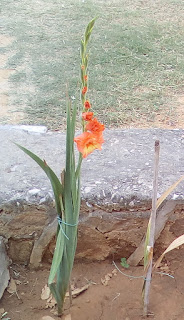
On the vegetable front, the doctor had advised my mother to eat lots of greens. So I went slightly berserk and  planted all kinds of greens- Malabar spinach (also known as pui), spinach, Amaranth greens, Methi, Argula, and of course lettuce.  As an experiment we also planted radish and broccoli. The radish is ready for harvesting while the broccoli has just germinated.
As the weather turned milder I realized that I have not done any baking this year.  So last Sunday I started officially the baking season by making an apple cake.  It turned out quite okay-soft and crumbly. 
This week with Deepavali around the corner, my mother and I are focusing on traditional sweets.  But after that, hopefully, I will get around to baking cakes and cookies for my students.

Friday, 7 October 2016

The benevelonce of UGC

The UGC has introduced new guidelines for M.Phil/Ph.D. candidates. There are some nice things in the guidelines. For example, it is now mandatory to have doctoral committees for each student who will monitor his/her progress.  Then there are stuff that makes one wonder. 
The government/powers to be/bureaucrats want to show how sensitive they are to women and that they understand how the society tilts towards men.  So there are now three clauses added to the guideline.  One is that a woman is entitled to 240 days of maternity leave.  I have no problems with it.
Currently, everyone is supposed to do 1 year of course work and 4 years of research work. If they are unable to publish a paper and submit their thesis within this stipulated time, they are given one year (365 days exactly) extension to complete the work.  The revised guidelines now state that the women candidates may be allowed a relaxation of one year for M.Phil and two years for Ph.D. in the maximum duration.  In addition to it, they can avail 240 days of maternity leave.
The second clause states that if a woman shifts here place of residence due to marriage or otherwise than she is allowed to take the data generated with her to the new University and continue the work there.
I have serious problems with these two clauses.  The first clause regarding the relaxation is actually a very patriarchal attitude couched in benevolent terms. Oh, the poor women.  You know how difficult it is for her.  Let us be more lenient towards her. I do not want such a condescending attitude.  I want level playing field where I do not want authorities to put obstacles on my path. I am willing to do the hard work and manage everything as long as I am treated as an equal.  The moment this clause is introduced, you automatically state that you do not consider women to be equal to men.  Further, in science, if anybody takes a two year relaxation (which implies long leave), you not be able to compete with the world. No one is going to stop their work just because you have taken a leave. By the time the candidate comes back, the hypothesis would be obsolete and the research would have moved in some other direction.  Also in science, it is the PI who writes grants and gets money.  So if a candidate takes it slow because the law allows you, what is the PI supposed to do? What answer does the PI give to the funding agency? 

The second clause regarding the women be allowed to take the data generated in one lab with her to another is also problematic. Students in science do not generate their own funds or their own ideas. The problem is usually given to them by the PI who has conceived the project, written the grant, got the money, and in the initial days (and in some cases till the end) tells the student what to do. So the clause essentially says that the student can take the PI's idea and move?  Move where?  Which lab? Because the student will need a lab to complete her work. And unless the PI has a collaboration with a researcher in the new place, the whole clause is doomed to fail.

But who can tell all this to UGC. They have issued a gazette notification and we have to follow.

Sunday, 28 August 2016

The Nilgais and us- the irony of greening a campus

This morning I noticed that the nilgais had paid my tiny garden a visit. The papaya leaves had all been eaten off (it is safe to assume that they will not get dengue) and the hibiscus had been partly eaten up. I am quite sure that they will pay a visit in the next couple of days to finish up the hibiscus. I gave the news to my mother and told her that there will be no flowers for the next few weeks for her puja.

When one looks at the old photos of the campus, one realizes how much has changed. In the 70s this was a barren land.  When the university set up its base here, and people started moving in, they also started planting trees. Today the entire campus is covered with trees.  Many of them are not the native flora of this region but never mind...it is green. So green, in fact, that most of the campus has been declared as forest area and therefore, protected land. If we want to build anything, we have to get clearance from the Ministry of Environment and Forest.  So the administration proposed two hostels and an extension to an academic building. The ministry shot it down.  Last heard, we got it approved through the PMO. 

The best bet would be to actually demolish the old houses and hostels and build new ones in that site.  We do not have any policy of maintenance, and therefore, many of the houses and hostels are in horrible condition. I really have no idea how the students manage to live in the old hostels.  To me, they are little better than slums. However, I understand that there is money to build new hostels and new homes but not to rebuild the old ones.

That brings in with direct conflict with nature- the one that we have assiduously built over the years. Do we destroy it in our quest to expand?  We will not only lose the green cover but also the nilgais, different species of birds, snakes, mongoose, civet cats and the rare fox that have made their home in the campus, enriching our lives. Where else in the city can we live in such close proximity with the wild?

I realize that there are no answers to such questions.  The only thing to do is to enjoy what is available and never mind the nilgais.

Thursday, 11 August 2016

The House that BJ Built- by Anuja Chauhan

As I am not in a mood to read heavy stuff (both H is for Hawk and The Emperor of Maladies are sitting in my book shelf unread), and as my sister-in-law had left "The House that BJ built" by Anuja Chauhan in my house after reading it, and as many people had said it was a laugh riot, I decided to read it.
We have clearly mastered the art of rom-com be it our movies or our books written in English. The Hero and the Heroine  have clearly been lifted from the pages of Mills and Boons and you know how it will all end. In summary, there are two love stories (better to give the readers a value for their money), 4 of the Thakur sisters who featured in an earlier book by the same author, their evil uncle and aunt and cousin, two Bhutanese who end up featuring in an item song, and a haveli that needs to be sold off because the sisters need the money.
In the end, the only thing I liked about the book was that it was set in Hailey Road in Delhi, where I went to my first school.
The rest...well, I won't go as far as the review that appears in The Ladies Finger, but definitely it was not a laugh riot as some of the reviewers had said.  And oh, some one needs to tell Anuja Chauhan that Dahlias and Amaltas do not flower at the same time.

Tuesday, 2 August 2016

Teaching Chemistry

When I decided to do Chemistry in college, it was based, on what I thought and still think, on very logical thinking. I was not going to spend hours memorizing biological names and had no inclination for math or physics. That left Chemistry and I believed that I sort of got it.  I used the same type of rationale later to switch from Chemistry to Biochemistry.
But learning chemistry and teaching chemistry are two different ball game.  Especially to a bunch of biologists who want to do only molecular biology.  Especially when I left chemistry after completing B.Sc.  Yet when my colleague fell ill, I jumped at the chance.  It would be fun, I thought, to go back to one's roots and re-learn the entire thing. Plus I was bored of teaching the same thing again and again, year after year, and I felt that if things are left as it was, I, too, would resort to using the same notes- believe me after teaching the same subject for few years to a bunch of students who do  not ask questions it really is tempting to use the same notes.
So here I am this year teaching physical and inorganic chemistry to the first year M.Sc students. It is scary because I do not know if I will do justice to the subject.  But at the same time I am sort of thrilled at the opportunity.
Most of the students have had some chemistry in their undergraduation though it was appalling to know that some them have not even been exposed to physical chemistry.  It promises to be an interesting semester.
This year, after much prodding from UGC, we have introduced tutorials for students.  However, the onus is again on the teacher. We do not have any teaching assistants.  So a 2-credit course with two classes per week essentially becomes a 3-credit course with three classes per week even though one of that class is optional. The tutorials are meant to help those students who are having difficulty with the subject but I do not know how it will pan out in the end.

Saturday, 23 July 2016

Game of the Genomes by Carl Zimmer

The human genome was sequenced in 2001. I still remember how skeptical many of my professors were at the beginning of the project. Whose genome are they going to sequence, was an oft-asked question. And then there were others who were enthusiastic about the venture. They felt that it would answer a whole lot of questions about our genome. In particular, they were sure we will know for sure what makes us so different from other animals.
Well, the 2001 paper raised a whole lot of questions rather than answering them. In particular, it was disappointing to know that the number of protein coding genes was about the same as that present in mice.  And that whole lot of our genome (in fact 98%) did not code for proteins. In fact, a majority appeared to not to code for anything.  It was called as junk DNA. 
The picture has changed a lot in the past 16 years. We now know that most of our genome codes for something. The trick is to understand what these do.
Over the years, genome sequencing has become popular. It can, after all, tell you whether you are at risk for a disease.  But what else can it tell you?
This is the question Carl Zimmer is trying to find out.  He got his entire genome sequence and then got the raw data from the company that did the sequencing.  Now he is getting it analyzed to understand the information stored in his genome.  The Game of the Genomes is an interesting read.

Sunday, 3 July 2016

Poor Ruby Rai

I feel sorry for the child. All she wanted was to pass in second division. She told that to her father who ensured that she came first in the subject, a subject she clearly has no idea about.  I do not know what the father was up to.  Did he not realize that the whole thing would blow up on their face in this era of instant sound bytes and TV  hunting for stories? 
I have no idea what the authorities are planning to achieve by arresting Ruby Rai. When she needs them most, her parents are on run.  The Minister who wrote a big list of achievements few days back on her Facebook is silent on this issue. She can, of course, claim that education is a state subject and therefore, under the purview of the State Education Minister. Bihar is fortunately not ruled by BJP and therefore, everyone in the Center can wash their hands off.
The rot in our education system run deep and every state is in a mess.  The cut-offs for admission to colleges in Delhi University are a joke. Seriously, they expect some one to get 99% in English?  What kind of examination was administered that a child could score 99% in English?
But who cares? Those who can send their child abroad. Those who can't...well, do they really matter?